VPC NAT Gateway
kubeovn-operator is currently classified as experimental. While the add-on is undergoing further integration, many Kube-OVN networking features have reached general availability (GA) in Harvester v1.9.0. For more information, see Feature Maturity.
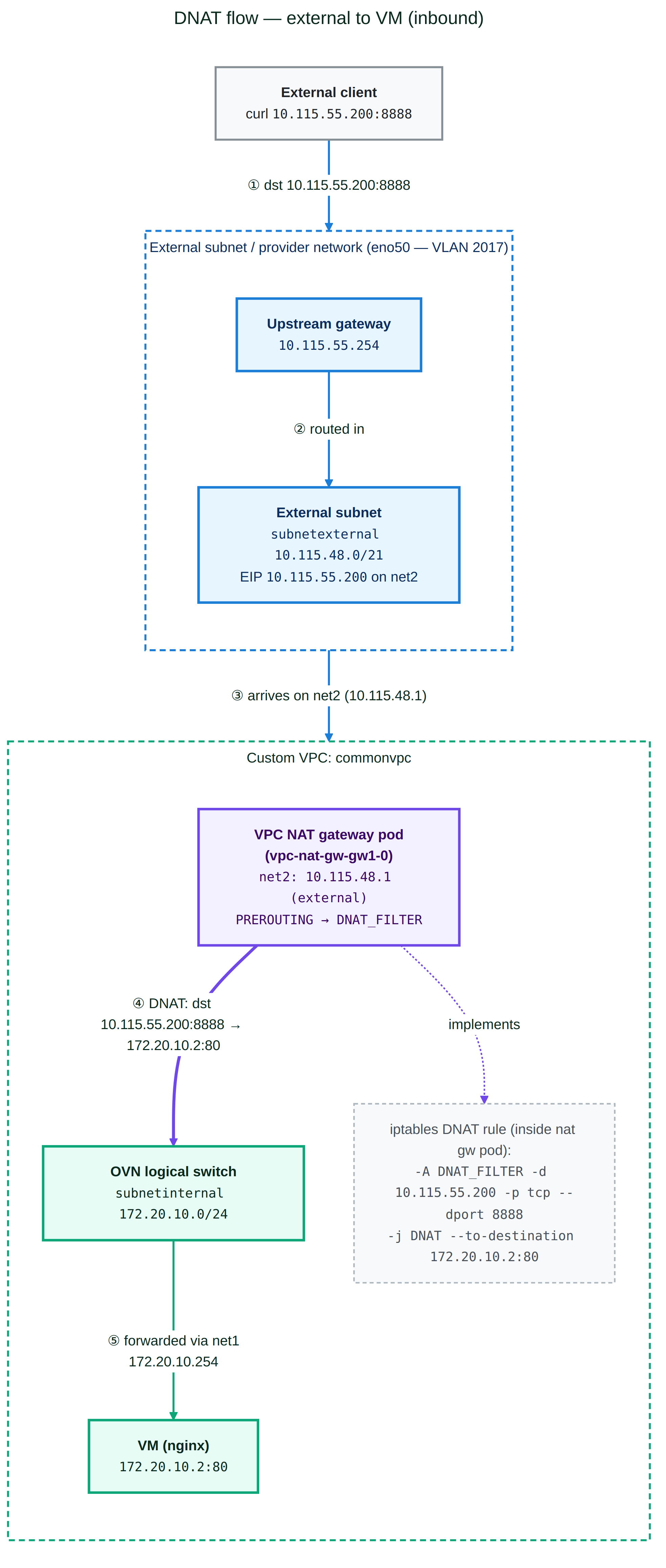
NAT enables external connectivity or inbound access: SNAT (Source NAT) allows VMs (or pods) inside a private overlay network / VPC to access external networks (e.g. internet) by translating their internal source IP to a public (or external-network-shared) IP. DNAT (Destination NAT) allows external hosts to reach internal VMs/pods by mapping a public IP / port to an internal private IP / port (e.g. to SSH into an internal VM).
Flexible networking for VPCs / overlay networks: Using NAT (SNAT / DNAT) with Kube-OVN means you can build isolated private subnets / VPCs and still allow controlled egress (outbound) or ingress (inbound) traffic. This is especially relevant for VM workloads managed by Harvester, where VMs may need internet access or to expose services externally.
Kube-OVN supports NAT via Kubernetes custom resources (CRDs), not just IP-tables directly. For example, resources like OvnEip, OvnSnatRule, OvnDnatRule (or their iptables-based equivalents) are used to define NAT behavior declaratively. In the context of Harvester, the VM orchestration (compute, storage, VM lifecycle,L2 VLAN based networking, underlay networking) is handled by Harvester; overlay networking — including routing, NAT, VPC/subnets — is handled by Kube-OVN. This separation allows for more scalable, flexible and clean networking.
KubeOVN as Secondary CNI
In Harvester v1.6.x and v1.7.x, Outbound and Inbound connectivity for VMs works only when attached to subnets created on default VPC (ovn-cluster) with natOutgoing as true.
With the introduction of kubeovn as secondary CNI in Harvester v1.8.0, Outbound and Inbound connectivity for VMs works on subnets created on any custom VPCs using VPC NAT Gateway functionality.
Create a Tenant Network
-
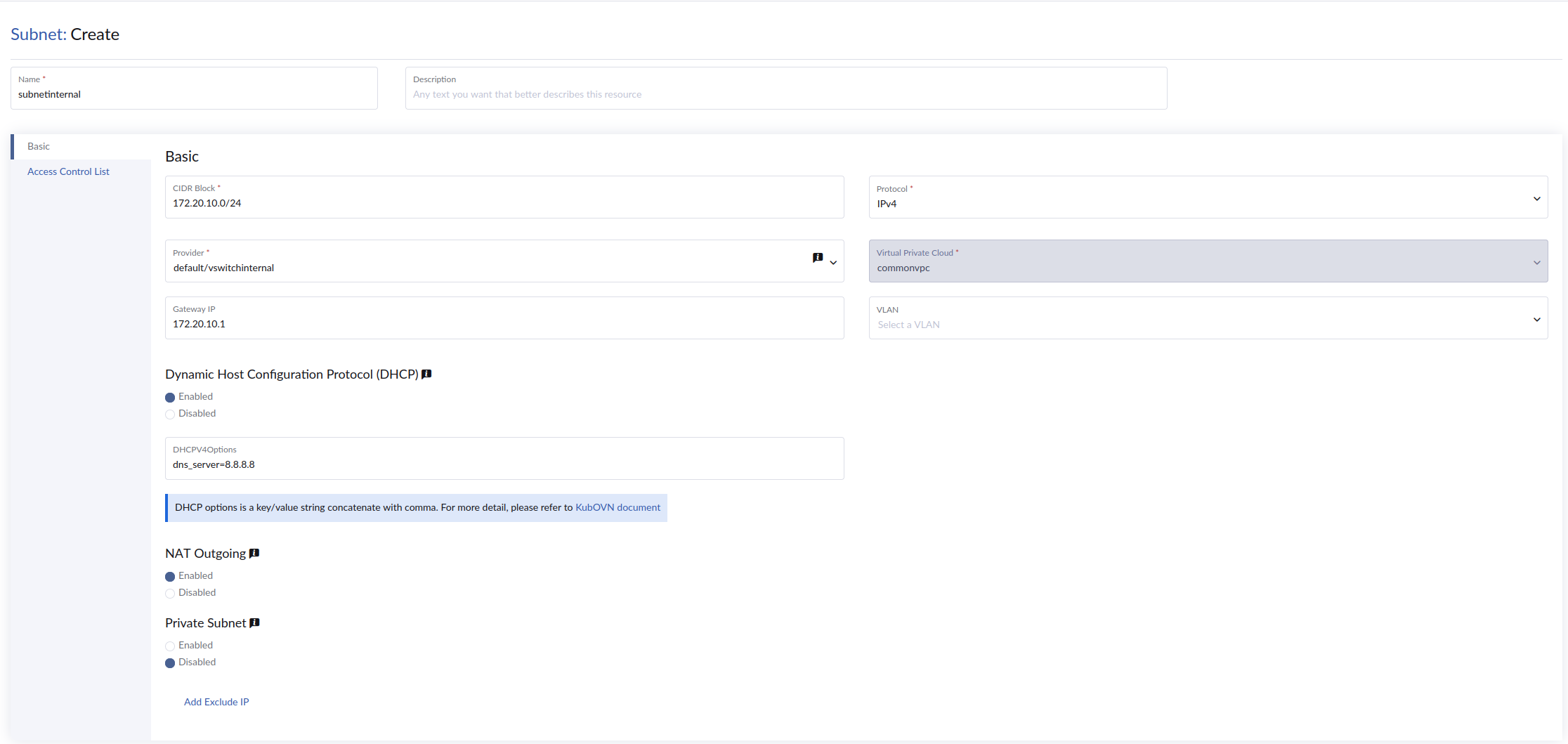
Create a subnet inside the VPC created in the previous step.
 important
When creating a subnet for a tenant network, ensure DHCP is enabled,
dns_serveris set to a valid DNS server IP address (for example,8.8.8.8), andnatOutgoingis set totrue. This configuration ensures that a default route is installed and DNS is resolved on virtual machines attached to these subnets.
The examples in this document use the following settings:
- Overlay network:
vswitchinternal - VPC:
commonvpc - Subnet (in
commonvpc):subnetinternal
Create an External Network
Follow the instructions in Underlay Configuration to create an external network.
VPC NAT Gateway
-
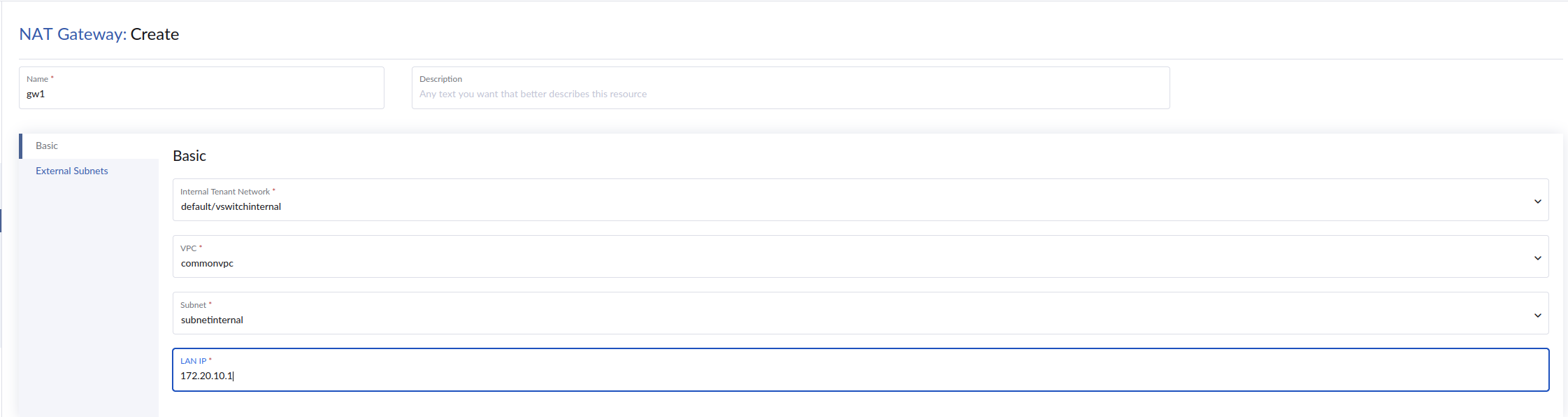
On the Harvester UI, go to Overlay Networks > NAT & Internet > Gateways.
-
Click Create.
-
Specify a unique name for the VPC NAT gateway.
-
On the Basic tab, configure the following settings:
-
Internal Tenant Network: Name of the internal tenant network (for example,
vswitchinternal) -
VPC VPC of the internal tenant network subnet (for example,
commonvpc) -
Subnet: Subnet of the internal tenant network (for example,
subnetinternal) -
LAN IP: Gateway IP address of the internal tenant network
-
-
On the External Subnets tab, configure the following settings:
- Subnet: Subnet of the underlay external network (for example,
subnetexternal)
- Subnet: Subnet of the underlay external network (for example,
-
Click Create.
Verification and Sample Outputs
-
Verify that a new StatefulSet (
vpc-nat-gw) and associated pod were created.$ kubectl get statefulset -n kube-system vpc-nat-gw-gw1 -o yaml
apiVersion: apps/v1
kind: StatefulSet
metadata:
creationTimestamp: "2026-06-05T22:42:17Z"
generation: 1
labels:
app: vpc-nat-gw-gw1
ovn.kubernetes.io/vpc-nat-gw: "true"
name: vpc-nat-gw-gw1
namespace: kube-system
resourceVersion: "18233827"
uid: ae7c9895-8a7f-46f6-b71d-be9f9b36b79a
spec:
persistentVolumeClaimRetentionPolicy:
whenDeleted: Retain
whenScaled: Retain
podManagementPolicy: OrderedReady
replicas: 1
revisionHistoryLimit: 10
selector:
matchLabels:
app: vpc-nat-gw-gw1
ovn.kubernetes.io/vpc-nat-gw: "true"
serviceName: ""
template:
metadata:
annotations:
k8s.v1.cni.cncf.io/networks: default/vswitchinternal, kube-system/vswitchexternal
ovn.kubernetes.io/vpc_nat_gw: gw1
vswitchexternal.kube-system.ovn.kubernetes.io/routes: '[{"dst":"0.0.0.0/0","gw":"10.115.55.254"}]'
vswitchinternal.default.ovn.kubernetes.io/ip_address: 172.20.10.1
vswitchinternal.default.ovn.kubernetes.io/logical_switch: subnetinternal
vswitchinternal.default.ovn.kubernetes.io/routes: '[{"dst":"10.55.0.0/16","gw":"172.20.10.1"}]'
labels:
app: vpc-nat-gw-gw1
ovn.kubernetes.io/vpc-nat-gw: "true"
spec:
affinity: {}
containers:
- command:
- sleep
- infinity
env:
- name: GATEWAY_V4
value: 10.115.55.254
- name: GATEWAY_V6
image: docker.io/kubeovn/vpc-nat-gateway:v1.16.1
imagePullPolicy: IfNotPresent
lifecycle:
postStart:
exec:
command:
- sh
- -c
- sysctl -w net.ipv4.ip_forward=1
name: vpc-nat-gw
resources: {}
securityContext:
allowPrivilegeEscalation: true
privileged: true
terminationMessagePath: /dev/termination-log
terminationMessagePolicy: File
dnsPolicy: ClusterFirst
restartPolicy: Always
schedulerName: default-scheduler
securityContext: {}
terminationGracePeriodSeconds: 0
updateStrategy:
type: RollingUpdate
status:
availableReplicas: 1
collisionCount: 0
currentReplicas: 1
currentRevision: vpc-nat-gw-gw1-5659bc556b
observedGeneration: 1
readyReplicas: 1
replicas: 1
updateRevision: vpc-nat-gw-gw1-5659bc556b
updatedReplicas: 1$ kubectl describe pod vpc-nat-gw-gw1-0 -n kube-system
Name: vpc-nat-gw-gw1-0
Namespace: kube-system
Priority: 0
Service Account: default
Node: hp-46/10.115.14.70
Start Time: Fri, 05 Jun 2026 22:42:18 +0000
Labels: app=vpc-nat-gw-gw1
apps.kubernetes.io/pod-index=0
controller-revision-hash=vpc-nat-gw-gw1-5659bc556b
ovn.kubernetes.io/vpc-nat-gw=true
statefulset.kubernetes.io/pod-name=vpc-nat-gw-gw1-0
Annotations: cni.projectcalico.org/containerID: 1b133ea1f17aac64c3d70bde83e1244fe07eb5206a78ec7c76f6099a450e093f
cni.projectcalico.org/podIP: 10.52.1.30/32
cni.projectcalico.org/podIPs: 10.52.1.30/32
k8s.v1.cni.cncf.io/network-status:
[{
"name": "k8s-pod-network",
"interface": "eth0",
"ips": [
"10.52.1.30"
],
"mac": "4a:26:76:cd:f3:fa",
"default": true,
"dns": {}
},{
"name": "default/vswitchinternal",
"interface": "net1",
"ips": [
"172.20.10.1"
],
"mac": "22:02:d9:04:e7:bb",
"dns": {}
},{
"name": "kube-system/vswitchexternal",
"interface": "net2",
"ips": [
"10.115.48.6"
],
"mac": "c6:1d:c3:e8:a5:76",
"dns": {},
"gateway": [
"10.115.55.254"
]
}]
k8s.v1.cni.cncf.io/networks: default/vswitchinternal, kube-system/vswitchexternal
ovn.kubernetes.io/vpc_nat_gw: gw1
ovn.kubernetes.io/vpc_nat_gw_init: true
vswitch2.default.ovn.kubernetes.io/vpc_cidrs: ["172.30.0.0/24"]
vswitchexternal.kube-system.ovn.kubernetes.io/allocated: true
vswitchexternal.kube-system.ovn.kubernetes.io/cidr: 10.115.48.0/21
vswitchexternal.kube-system.ovn.kubernetes.io/gateway: 10.115.55.254
vswitchexternal.kube-system.ovn.kubernetes.io/ip_address: 10.115.48.6
vswitchexternal.kube-system.ovn.kubernetes.io/logical_switch: subnetexternal
vswitchexternal.kube-system.ovn.kubernetes.io/mac_address: c6:1d:c3:e8:a5:76
vswitchexternal.kube-system.ovn.kubernetes.io/pod_nic_type: veth-pair
vswitchexternal.kube-system.ovn.kubernetes.io/provider_network: pn1
vswitchexternal.kube-system.ovn.kubernetes.io/routed: true
vswitchexternal.kube-system.ovn.kubernetes.io/routes: [{"dst":"0.0.0.0/0","gw":"10.115.55.254"}]
vswitchexternal.kube-system.ovn.kubernetes.io/vlan_id: 2017
vswitchinternal.default.ovn.kubernetes.io/allocated: true
vswitchinternal.default.ovn.kubernetes.io/cidr: 172.20.10.0/24
vswitchinternal.default.ovn.kubernetes.io/gateway: 172.20.10.1
vswitchinternal.default.ovn.kubernetes.io/ip_address: 172.20.10.1
vswitchinternal.default.ovn.kubernetes.io/logical_router: commonvpc
vswitchinternal.default.ovn.kubernetes.io/logical_switch: subnetinternal
vswitchinternal.default.ovn.kubernetes.io/mac_address: 22:02:d9:04:e7:bb
vswitchinternal.default.ovn.kubernetes.io/pod_nic_type: veth-pair
vswitchinternal.default.ovn.kubernetes.io/routed: true
vswitchinternal.default.ovn.kubernetes.io/routes: [{"dst":"10.55.0.0/16","gw":"172.20.10.1"}]
vswitchinternal.default.ovn.kubernetes.io/vpc_cidrs: ["172.20.10.0/24"]
Status: Running
IP: 10.52.1.30
IPs:
IP: 10.52.1.30
Controlled By: StatefulSet/vpc-nat-gw-gw1
Containers:
vpc-nat-gw:
Container ID: containerd://4e0d66777f1e56f6402e1106fba2feb9b4a6f0eaa467101a5f7b159ff9981c04
Image: docker.io/kubeovn/vpc-nat-gateway:v1.16.1
Image ID: docker.io/kubeovn/vpc-nat-gateway@sha256:59afff3ee0583378ae73ead77f3459745fef300d111f3a5e60ca555b19ca8e7b
Port: <none>
Host Port: <none>
Command:
sleep
infinity
State: Running
Started: Fri, 05 Jun 2026 22:42:29 +0000
Ready: True
Restart Count: 0
Environment:
GATEWAY_V4: 10.115.55.254
GATEWAY_V6:
Mounts:
/var/run/secrets/kubernetes.io/serviceaccount from kube-api-access-97xmd (ro)
Conditions:
Type Status
PodReadyToStartContainers True
Initialized True
Ready True
ContainersReady True
PodScheduled True
Volumes:
kube-api-access-97xmd:
Type: Projected (a volume that contains injected data from multiple sources)
TokenExpirationSeconds: 3607
ConfigMapName: kube-root-ca.crt
Optional: false
DownwardAPI: true
QoS Class: BestEffort
Node-Selectors: <none>
Tolerations: node.kubernetes.io/not-ready:NoExecute op=Exists for 300s
node.kubernetes.io/unreachable:NoExecute op=Exists for 300s
Events: <none> -
Verify that the network interfaces of the
vpc-nat-gwpod are attached correctly (net1to the internal network andnet2to the external network).$ kubectl exec -it vpc-nat-gw-gw1-0 -n kube-system -- /bin/bash
vpc-nat-gw-gw1-0:/kube-ovn# ip addr show
1: lo: <LOOPBACK,UP,LOWER_UP> mtu 65536 qdisc noqueue state UNKNOWN group default qlen 1000
link/loopback 00:00:00:00:00:00 brd 00:00:00:00:00:00
inet 127.0.0.1/8 scope host lo
valid_lft forever preferred_lft forever
inet6 ::1/128 scope host proto kernel_lo
valid_lft forever preferred_lft forever
2: eth0@if9727: <BROADCAST,MULTICAST,UP,LOWER_UP> mtu 1450 qdisc noqueue state UP group default qlen 1000
link/ether 4a:26:76:cd:f3:fa brd ff:ff:ff:ff:ff:ff link-netnsid 0
inet 10.52.1.30/32 scope global eth0
valid_lft forever preferred_lft forever
inet6 fe80::4826:76ff:fecd:f3fa/64 scope link proto kernel_ll
valid_lft forever preferred_lft forever
9728: net1@if9729: <BROADCAST,MULTICAST,UP,LOWER_UP> mtu 1450 qdisc noqueue state UP group default
link/ether 22:02:d9:04:e7:bb brd ff:ff:ff:ff:ff:ff link-netnsid 0
inet 172.20.10.1/24 brd 172.20.10.255 scope global net1
valid_lft forever preferred_lft forever
inet6 fe80::2002:d9ff:fe04:e7bb/64 scope link proto kernel_ll
valid_lft forever preferred_lft forever
9730: net2@if9731: <BROADCAST,MULTICAST,UP,LOWER_UP> mtu 1500 qdisc noqueue state UP group default
link/ether c6:1d:c3:e8:a5:76 brd ff:ff:ff:ff:ff:ff link-netnsid 0
inet 10.115.48.6/21 brd 10.115.55.255 scope global net2
valid_lft forever preferred_lft forever
inet 10.115.55.200/21 scope global secondary net2
valid_lft forever preferred_lft forever
inet6 fe80::c41d:c3ff:fee8:a576/64 scope link proto kernel_ll
valid_lft forever preferred_lft forever
vpc-nat-gw-gw1-0:/kube-ovn# ip route show
default via 10.115.55.254 dev net2 onlink
10.55.0.0/16 via 172.20.10.1 dev net1
10.115.48.0/21 dev net2 proto kernel scope link src 10.115.48.6
169.254.1.1 dev eth0 scope link
172.20.10.0/24 dev net1 proto kernel scope link src 172.20.10.1
172.30.0.0/24 via 172.20.10.1 dev net1 -
Verify that the provider network bridge (
br-pn1) is present and that the patch port (patch-localnet.subnetexternal-to-br-int) connects the external subnet tobr-int.$ kubectl exec -it ovs-ovn-q92zk -n kube-system -- /bin/bash
Defaulted container "openvswitch" out of: openvswitch, hostpath-init (init)
nobody@hp-65:/kube-ovn$ ovs-vsctl show
54ef5649-9fe6-4944-865b-30a591c95121
Bridge br-pn1
Port br-pn1
Interface br-pn1
type: internal
Port patch-localnet.subnetexternal-to-br-int
Interface patch-localnet.subnetexternal-to-br-int
type: patch
options: {peer=patch-br-int-to-localnet.subnetexternal}
Port eno50
trunks: [0, 2017]
Interface eno50
Bridge br-int
fail_mode: secure
datapath_type: system
Port br-int
Interface br-int
type: internal
Port "6159403e_net1_h"
Interface "6159403e_net1_h"
Port mirror0
Interface mirror0
type: internal
Port ovn0
Interface ovn0
type: internal
Port patch-br-int-to-localnet.subnetexternal
Interface patch-br-int-to-localnet.subnetexternal
type: patch
options: {peer=patch-localnet.subnetexternal-to-br-int}
Port "7e8b0_37a8eec_h"
Interface "7e8b0_37a8eec_h"
Port "6159403e_net2_h"
Interface "6159403e_net2_h"
ovs_version: "3.5.3"
SNAT for External Connectivity from Overlay VMs
-
Create an external IP.
-
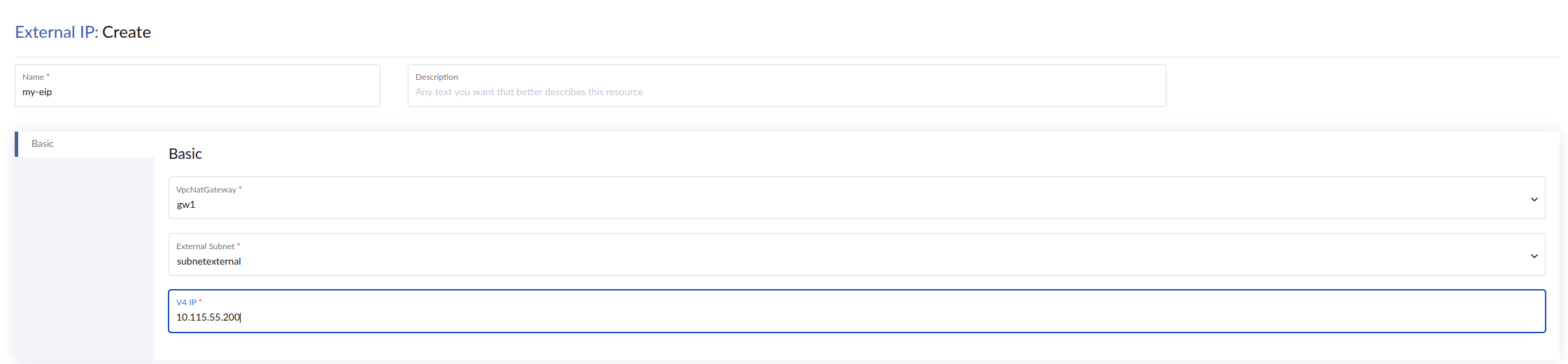
On the Harvester UI, go to Overlay Networks > NAT & Internet > External IPs.
-
Click Create.
-
Specify a unique name for the external IP.
-
On the Basic tab, configure the following settings:
-
VPC NAT GW: Name of the VPC NAT gateway (for example,
gw1) -
External Subnet: Subnet of the underlay external network (for example,
subnetexternal) -
v4 IP: Available IP address from the external subnet CIDR range to be used as a public IP for SNAT/DNAT
-
-
Click Create.
-
-
Create an SNAT rule.
-
On the Harvester UI, go to Overlay Networks > NAT & Internet > Source Rules.

-
Click Create.
-
Specify a unique name for the SNAT rule.
-
On the Basic tab, configure the following settings:
-
EIP: External IP (for example,
my-eip) -
Internal CIDR: CIDR of the internal tenant subnet
-
-
Click Create.
-
Verification and Sample Outputs
-
Verify the status of the external IP.
$ kubectl get eip
NAME     IP              MAC                 NAT         NATGWDP   READY
my-eip 10.115.55.200 52:1b:4f:1d:14:ce dnat,snat gw1 true -
Verify that the SNAT rule was created in the iptables of the VPC NAT gateway pod.
Example:
vpc-nat-gw-gw1-0:/kube-ovn# iptables-legacy-save -t nat
# Generated by iptables-save v1.8.11 on Sat Mar  7 00:28:34 2026
*nat
:PREROUTING ACCEPT [2949:373475]
:INPUT ACCEPT [107:31097]
:OUTPUT ACCEPT [0:0]
:POSTROUTING ACCEPT [1:60]
:DNAT_FILTER - [0:0]
:EXCLUSIVE_DNAT - [0:0]
:EXCLUSIVE_SNAT - [0:0]
:SHARED_DNAT - [0:0]
:SHARED_SNAT - [0:0]
:SNAT_FILTER - [0:0]
-A PREROUTING -j DNAT_FILTER
-A POSTROUTING -j SNAT_FILTER
-A SHARED_SNAT -s 172.20.10.0/24 -o net2 -j SNAT --to-source 10.115.55.200 --random-fully
-A SNAT_FILTER -j EXCLUSIVE_SNAT
-A SNAT_FILTER -j SHARED_SNAT
COMMIT
Create a Virtual Machine
-
Create a virtual machine and attach it to the
vswitchinternaloverlay network. -
From within the virtual machine's guest operating system, ping an external IP address (for example, 8.8.8.8). The ping must succeed.
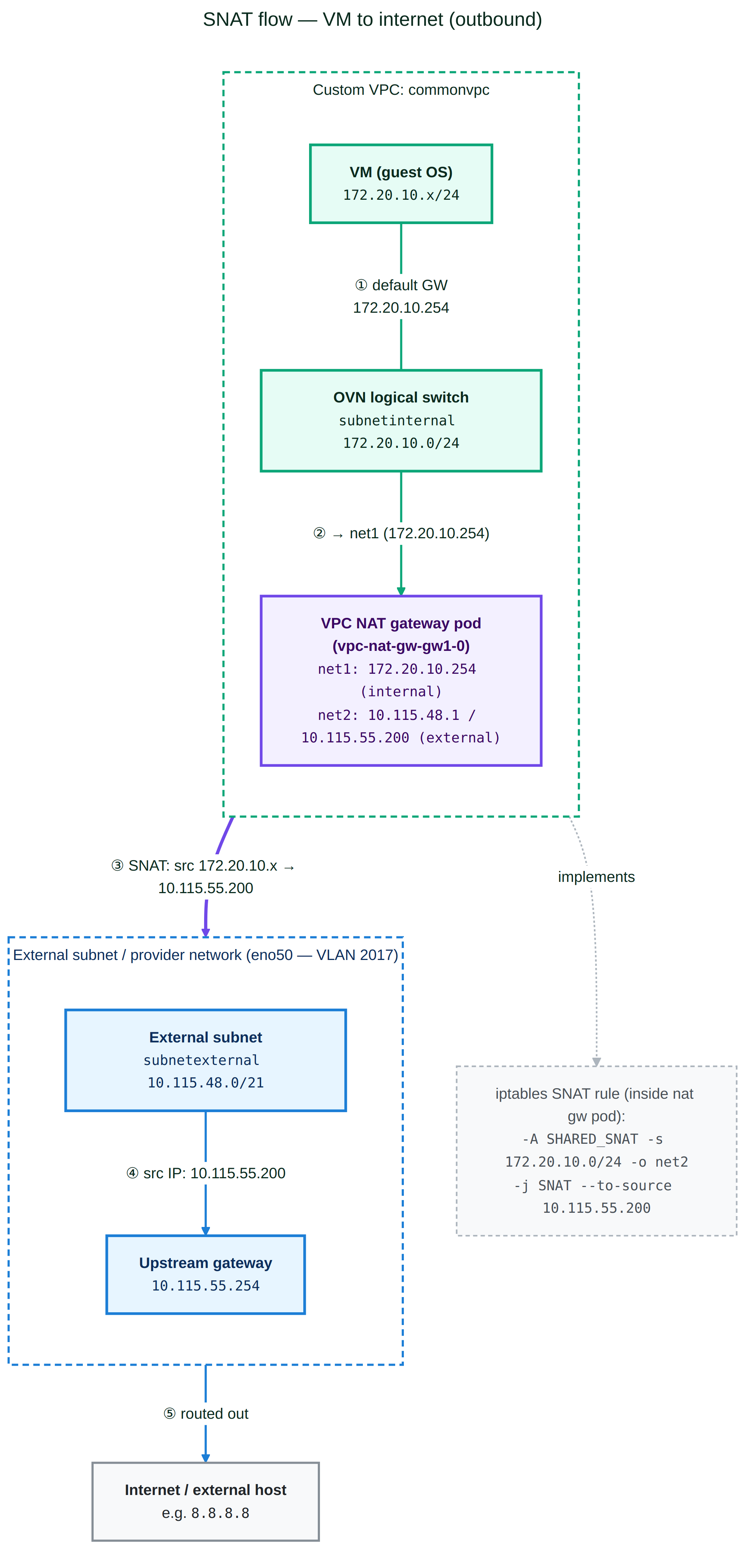
Traffic leaving the virtual machine enters the vpc-nat-gw pod on interfacenet1 and routes out through interface net2. An iptables SNAT rule translates the source IP from the internal subnet (172.20.10.0/24) to the external IP (10.115.55.200) for external connectivity.
DNAT for inbound access (external to overlay Virtual Machines)
-
Create a DNAT Rule
-
On the Harvester UI, go to Overlay Networks > NAT & Internet > Destination Rules.
-
Click Create.
-
Specify a unique name for the DNAT rule.
-
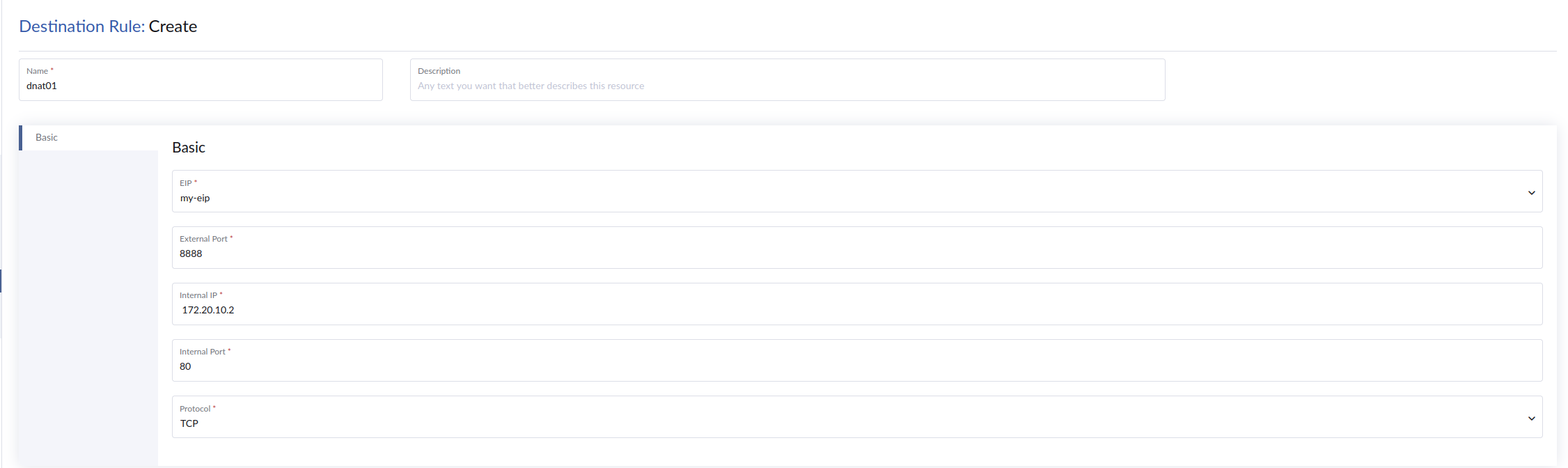
On the Basic tab, configure the following settings:
-
EIP: External IP assigned to the VPC NAT gateway (for example,
my-eip) -
External Port: Port on which incoming traffic is received from external clients
-
Internal IP: Destination IP address to which incoming traffic is forwarded (the IP address of the target overlay virtual machine)
-
Internal Port: Destination port on the internal host to which incoming traffic is translated and forwarded
-
Protocol
TCPorUDP
-
-
Click Create.
-
Verification and Sample Outputs
Verify that the DNAT iptables rule exists inside the VPC NAT gateway pod.
Example:
vpc-nat-gw-gw1-0:/kube-ovn# iptables-legacy -t nat -L -n -v 2>/dev/null | grep -E "DNAT"
3051  392K DNAT_FILTER  all  --  *      *       0.0.0.0/0            0.0.0.0/0
Chain DNAT_FILTER (1 references)
3051  392K EXCLUSIVE_DNAT  all  --  *      *       0.0.0.0/0            0.0.0.0/0
3051  392K SHARED_DNAT  all  --  *      *       0.0.0.0/0            0.0.0.0/0
Chain EXCLUSIVE_DNAT (1 references)
Chain SHARED_DNAT (1 references)
    1    60 DNAT       tcp  --  *      *       0.0.0.0/0            10.115.55.200        tcp dpt:8888 to:172.20.10.2:80
Create a Virtual Machine
Create a virtual machine attached to the overlay network on subnetinternal, then install NGINX on the virtual machine to verify inbound connectivity.
$ sudo apt update
$ sudo apt install nginx -y
$ sudo systemctl status nginx

test nginx locally on the VM
$ curl http://127.0.0.1

Now curl -k http://10.115.55.200:8888 from external must be successful